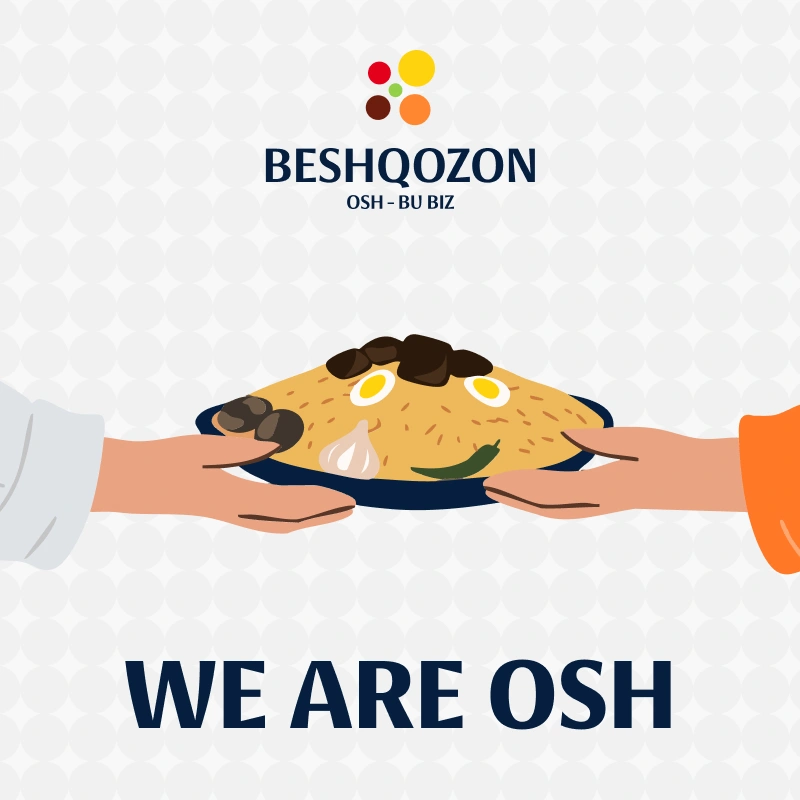
In Uzbekistan, plov (osh) is not just food. It is a cultural code that embodies rituals and traditions passed down for centuries. Plov is cooked in giant cauldrons and served through an ancient ritual — from hand to hand. This gesture carries not only the warmth of the dish, but also the warmth of human connection. There is even a saying: “osh yerkanmizda” — literally, “we have a reason for plov.” People use it to mark any important moment in life: the birth of a child, a wedding, a holiday, even buying a car. Sometimes it is used as a joke or a meme. But the meaning is always the same: plov is a reason to come together. Founded in 1999, Beshqozon is the largest plov center in Uzbekistan and the first restaurant chain dedicated exclusively to plov. Over 26 years, more than 80 million guests have visited its locations. Every day, across all branches, more than 10,000 kilograms of plov are prepared in over 100 cauldrons. For locals and tourists alike, Beshqozon is not just a restaurant. It is a cultural institution, where the kitchen becomes a stage and cooking turns into a ritual. Even before the rebrand, over 1,000 media outlets and bloggers wrote about Beshqozon, reaching an audience of more than 1 billion views. Yet despite this fame, the brand lacked identity, positioning, and a scalable strategy.
Problem
Beshqozon was loved, but it remained undefined. Its popularity was tied mainly to its first branch near the Tashkent TV Tower in Yunusabad. Outside the capital, the brand was seen more as a tourist spot than a national symbol. A persistent stereotype painted Beshqozon’s plov as “too expensive,” even though prices were lower than most mid-segment competitors. The old logo was inflexible, did not work in digital, and failed to reflect the scale of the brand. Imitators began to appear on the market, copying the name and visual identity. Some restaurants abroad even replicated elements of Beshqozon. The brand was losing control of its image and risked remaining a local legend with no future. The challenge was clear: to change perception, break stereotypes, and transform Beshqozon into the first nationwide fast-casual chain — accessible to everyone while preserving the cultural code of plov.
Solution
We found the key in the heart of Uzbek culture — the ritual of passing plov from hand to hand. It is not just a gesture, but a living chain where everyone becomes part of the tradition. This simple act became the foundation of the new identity. The formula “We Are Osh” became the brand’s central idea. We created a visual metaphor — two hands passing a plate of plov. This became the core of the identity system, universal and self-explanatory. To emphasize national scale, we designed unique symbols for each type of plov, inspired by regional recipes like Samarkand’s zigir-osh or plov cooked in olive oil. These symbols were integrated into patterns and communications. Brand patterns were created from scratch, encoding graphic metaphors of the cauldron, rice, carrots, meat, oil, and fire. They preserved the spirit of Uzbek ornamentation but were stripped of folklore noise and translated into a modern design language. These patterns became the foundation for packaging, uniforms, interiors, souvenirs, and digital communications. We also developed a custom typeface inspired by Uzbek architecture and ornamentation, refined into a modern, digital-friendly tool. The identity became the basis of a scalable brand architecture: Express — food courts, Delivery — mobile app, Catering — for B2B, and even the Plov Festival. The rebrand was unveiled at Mazza Fest, the country’s largest gastronomic festival. We built a mirror installation of the logo, decorated the space with branded patterns, held tastings and live cooking shows, and launched a collaboration with Coca-Cola. Over 20,000 guests directly engaged with the brand.
Result
After the rebrand, Beshqozon changed its perception and strengthened its market position (figures provided by Beshqozon’s marketing department): Loyalty growth. The formula “We Are Osh” increased engagement: the share of returning guests grew by +18% in the first 3 months. Breaking barriers. The stereotype of “expensive plov” disappeared: more than 70% of surveyed customers now perceive prices as affordable. LTV. The average lifetime value of a customer grew by +22% within a year. Traffic. Branch visits increased by +25%, and delivery orders by +40% compared to the previous year. Festival. More than 20,000 guests directly interacted with the brand at Mazza Fest. New channels. Within 3 months after the rebrand launch, Beshqozon received 5 partnership offers from retail chains and food courts. Young audience. Social media engagement among users under 30 grew by +35%. Today, Beshqozon operates 4 branches. Within the year, the fifth branch and the first food court format will open — a step toward building a national network. The main result — Beshqozon evolved from a local legend into a cultural platform and a symbol of modern Uzbek cuisine.